
Phoenix metro · Arizona
Scottsdale
One name covering at least four genuinely different housing markets.
Scottsdale is treated as a single market far more often than it behaves like one. A lock-and-leave condominium a short walk from Old Town, a 1950s block ranch south of Thomas, a 1980s patio home in McCormick Ranch and a hillside custom home above Pinnacle Peak share a postal identity and very little else. They differ in construction era, structural system, lot constraint, renovation ceiling and what it costs to change anything.
Reading Scottsdale well means knowing which of those markets a given address actually sits in, and what that implies for the work ahead of you.
Housing and architectural character
The south of the city, roughly the 85251 and 85257 areas, is largely post-war: single-story block and wood-frame ranches on flat, regular lots. Many were built before the era of the great room and the double-height ceiling, which is precisely what makes them interesting — the structural system is usually simple, non-bearing interior walls are common, and the gap between what the house is and what it could be is unusually wide for the money.
Central Scottsdale adds the 1970s and 1980s planned communities: McCormick Ranch, Gainey Ranch, Scottsdale Ranch. Patio homes, townhomes and single-family around golf and man-made lakes. Solid construction, generous mature landscaping, and interiors that frequently date rather than fail — popcorn ceilings, compartmented plans, small windows facing the wrong way.
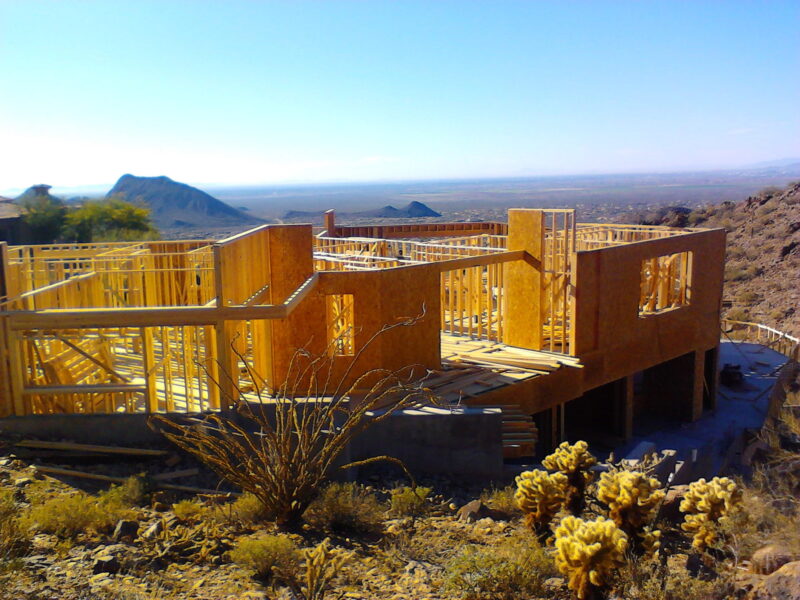
North Scottsdale is a different discipline entirely. DC Ranch, Silverleaf, Troon North, Grayhawk, Pinnacle Peak and the communities running up toward Desert Mountain are dominated by custom and semi-custom homes from the 1990s onward, many on hillside or boulder-strewn lots. Steel, spanning glass, deep overhangs, flat and low-slope roofs, complex mechanical systems and significant site work sitting underneath everything.
Old Town and the Waterfront add mid- and high-rise condominium stock, which is a different asset class again — HOA structure, reserve funding, building envelope and rental policy matter more than finishes.
Areas and neighborhoods
South Scottsdale carries most of the mid-century inventory and the most renovation headroom. Central Scottsdale — McCormick Ranch, Gainey Ranch, Scottsdale Ranch — offers established landscaping and amenity, generally at a lower cost per square foot than comparable new build further north.
North Scottsdale spans a wide range: Grayhawk and DC Ranch as large master-planned communities, Troon North and Pinnacle Peak as hillside custom territory, Silverleaf at the upper end. Old Town and the Scottsdale Waterfront concentrate the walkable condominium market.
Each behaves differently enough that a strategy built for one rarely transfers to another.
Location and lifestyle context
Practical geography matters here. The Scottsdale Airpark is a significant employment center in its own right, which changes the commute calculation for the north of the city. Old Town concentrates restaurants, galleries and nightlife — attractive to some buyers, a genuine consideration for others, particularly where short-term rentals are common on a street.
The city runs long north to south. Thirty minutes of driving separates its ends, and the character at each is not the same. Anyone weighing Scottsdale against a neighboring city should be specific about which Scottsdale they mean.
Investor relevance
Scottsdale supports several distinct strategies, and they do not compete for the same properties.
Value-add sits most obviously in the south and center: older single-family and patio homes where condition, layout and finish are holding back position. This is the segment where a construction-informed read pays for itself, because the difference between a cosmetic refresh and a structural reconfiguration is often invisible in listing photographs and decisive to the return.
Condominium rental in and around Old Town is a separate business, governed less by construction and more by HOA documents, reserve health, building envelope history and rental restrictions. Read the documents before the finishes.
Short-term rental is prevalent in parts of the city. Rules at both state and municipal level have changed repeatedly and continue to, so treat any assumption about permitted use as something to verify for the specific property and the current regulations rather than inherit from a neighbor.
Small multifamily exists but is not Scottsdale’s strength — the stock is thinner here than in central Phoenix or Tempe, and pricing generally reflects the address rather than the rent roll.
Land and site considerations
Remaining residential land is concentrated in the north, and most of what is left is constrained in some way. That is usually why it is still available.
The city’s Environmentally Sensitive Lands Ordinance governs much of the northern desert area, setting requirements around natural area open space, disturbance limits and hillside development. A parcel’s buildable envelope can be materially smaller than its acreage suggests, and where the house can sit may be decided by the terrain rather than the view.
Practical questions that decide a hillside lot: how the driveway achieves grade, where cut and fill balance, what the rock conditions do to excavation and foundation cost, how utilities reach the building pad, and what drainage does across the site in a monsoon. These are answerable before purchase, and considerably cheaper to answer then.
Infill lots appear periodically in the south and center — teardown candidates on established streets. Different problem, different arithmetic: demolition, existing utility connections, and neighborhood context all change the calculation.
Development context
Scottsdale development is largely infill, replacement and completion of existing master plans rather than outward expansion. The city has a long-established design review culture and, in the northern desert areas, a strong preservation emphasis in its land-use regulation.
For anyone considering a project here, the constraint set is generally the determining factor rather than the land cost alone. Understanding what a parcel permits — and what the review process will expect — belongs at the front of the process.
Buying in Scottsdale
Decide which Scottsdale you are actually buying into before comparing prices, because cost per square foot means very different things across those sub-markets.
On older homes, ask what the structure allows before falling for the layout you imagine. Load paths, roof framing, slab condition, and the age and routing of mechanical, electrical and plumbing systems determine whether the renovation you have in mind is a straightforward project or a substantial rebuild.
On hillside homes, the site is part of the purchase. Retaining, drainage, driveway grade and foundation conditions are real costs that outlast the finishes.
On condominiums, the building and its governance are the asset as much as the unit.
Selling in Scottsdale
Scottsdale buyers are comparing widely, frequently against new construction with current finishes and current systems. Presentation is not decoration here — it is the argument that your property is worth the premium over building new.
The most common missed opportunity is the property with real potential and no way for a buyer to see it. Where a home’s value is in what it could become, showing that credibly — what the structure permits, what the work would involve — reaches the buyer who is willing to pay for potential rather than the one who discounts for condition.
Sequencing matters too. Knowing which pre-sale work returns more than it costs, and which does not, is a construction question before it is a marketing one.
My perspective here
Grace’s professional background is concentrated precisely where Scottsdale is most demanding. She ran construction operations for a North Scottsdale hillside custom-home builder, on projects that typically ran eighteen to twenty-four months, coordinating design through construction and the subcontractor, municipal, HOA and inspection relationships that go with them.
That means hillside sites, complex structures, long build programs and the specific ways a North Scottsdale project goes wrong are familiar territory rather than an abstraction — as is the mid-century stock in the south, where the question is usually what the existing structure will permit.
This perspective informs how a property is evaluated. It does not replace the inspectors, engineers, architects, appraisers or attorneys whose work it is — it means knowing what to ask them, and how to read the answers. More about that background
Common questions about Scottsdale
Why does cost per square foot vary so much within Scottsdale?
Because the construction behind it varies enormously. A single-story block ranch on a flat lot, a 1980s patio home, and a hillside custom home with significant site work, steel framing and spanning glass are different buildings in every respect that drives cost. Comparing them on a single per-square-foot figure across the whole city tells you very little.
Is a mid-century home in South Scottsdale a good renovation candidate?
Often, yes — the simple structural systems typical of that era tend to allow layout changes without extraordinary intervention. But it depends on the specific house. The questions that decide it are the condition of the slab and roof framing, the age and routing of the mechanical, electrical and plumbing systems, and whether the walls you want to remove are carrying load. Those are answerable before you make an offer.
What makes a North Scottsdale hillside lot expensive to build on?
Rarely the house itself. Site work drives it: achieving driveway grade, cut and fill, rock excavation, retaining, drainage and getting utilities to the building pad. Two lots with similar asking prices and similar views can differ substantially once site work is priced, which is why that work belongs in the evaluation rather than after it.
Can I short-term rent a property in Scottsdale?
Rules at both state and city level have changed repeatedly and continue to evolve, and requirements can differ by property. Treat it as something to verify for the specific address against current regulations and any applicable HOA restrictions, rather than assuming from what a neighboring property appears to be doing.